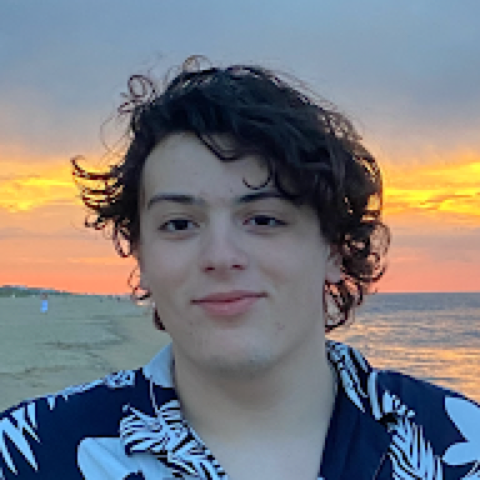
We are delighted to welcome Giovanni Romanello Mazzeo, who joined the lab this fall as a PhD student in the Department of Integrative Biology. Giovanni graduated from the University of Virginia in May 2026 with a double major in Mathematics and Philosophy, where he did research on detecting seasonal balancing selection. He is broadly interested in methods development and theory in population genetics and phylogenetics, including new formalisms for horizontal gene transfer, analogous to ancestral recombination graphs, and statistical inference over spaces of trees and graphs. Welcome, Giovanni!

Congratulations to Maya Lemmon-Kishi, who has graduated with her PhD — and rocked the cap and gown! Maya completed her doctorate in the Computational Biology graduate group, developing phylogenetics-based methods to expand the use of ancient environmental DNA.


How might climate-driven shifts to species’ geographical ranges impact pathogen transmission and infection outcomes? A new publication in Biotropica, led by postdoc Dr. Emma Steigerwald, addresses this question with frogs that expanded upslope to become the highest-living amphibians in the world.

Have you heard of the incredible rainbow of color variation in strawberry poison frogs (O. pumilio) in Bocas del Toro, Panama? A new study addressing this perplexing system, led by recent Nielsen lab alum Dr. Diana Aguilar-Gómez, was just published in Current Biology.

Side-blotched lizards play a rock-paper-scissors game between mating types. Nielsen lab alum Dr. Ammon Corl finds the genetic underpinnings of this system and reveals new twists in the story of this classical system in behavioral ecology. NYT story here.

Nielsen Lab Retreat 2025.
Lab postdoc Dr. Emma Steigerwald begins a new fellowship on historic and ancient sedimentary DNA of amphibians and their chytrid pathogen, funded by the NSF Postdoctoral Research Fellowship Program and University of California Chancellor’s Fellowship Program.